| General | Console | Combinations | Recordings | Demo | Gallery | Settings | Return to Main Page |
Settings View
By default, Napo is configured to use MIDI channel 0 for the main manual, channel 1 for the second manual, and so on up to the pedal. If your MIDI setup is like this, then there is no need to configure anything, but usually you have to adapt the MIDI channel settings to your MIDI hardware setup. This, and many other things, can be done in the Settings view.
At the right top of this view there is a button which opens an action menu:
This action menu offers the following entries:
- About the App: Displays the app version, the framework version and background information like the origin of the sample set and license notes.
- In-App Purchases...: If the app offers in-app purchases, you can get a list of the available items by tapping this entry. The in-app purchase list lets you purchase items, restore particular previously purchased items, and restore all previously purchased items in one step. All purchases are non-consumable, i.e. you will never be charged twice for the same item purchased with the same App Store account.
- Visit Support Page: Opens Safari and navigates to the support web page of the app.
- Reset Settings: Resets all settings to their factory values.
The Settings view is split into four subviews and an additional view where you can load and save the settings. The subviews can be selected by tapping buttons that sit above the main icon bar:
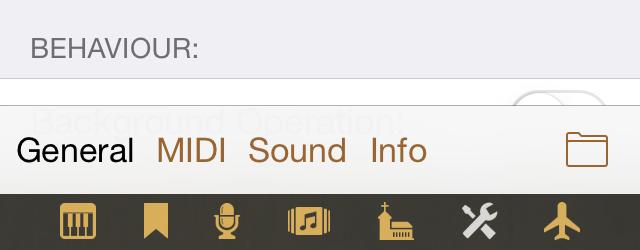 There are currently the following subviews:
| General | In this view, you can configure the appearance of the Console view and behaviour like the transposing functionality and support for wireless and virtual MIDI operation. |
| MIDI | This view serves for setting the MIDI channels for the keyboards / the pedal, MIDI controllers for volume sliders / swell pedals, and MIDI note on/off messages to control stops, tremulants, couplers and combination functionality. |
| Sound | Use this view to select the sample rate and buffer size and configure the reverb. |
| Info | This view shows information about disk space and sample files. |
| Save/Load | This view, symbolised by a folder icon, is for managing saved settings. Saving and loading settings can be useful for example if you happen to operate the app with different MIDI consoles. |
In the following we give a short description of the subviews, their sections and the particular settings.
General - Appearance ↑
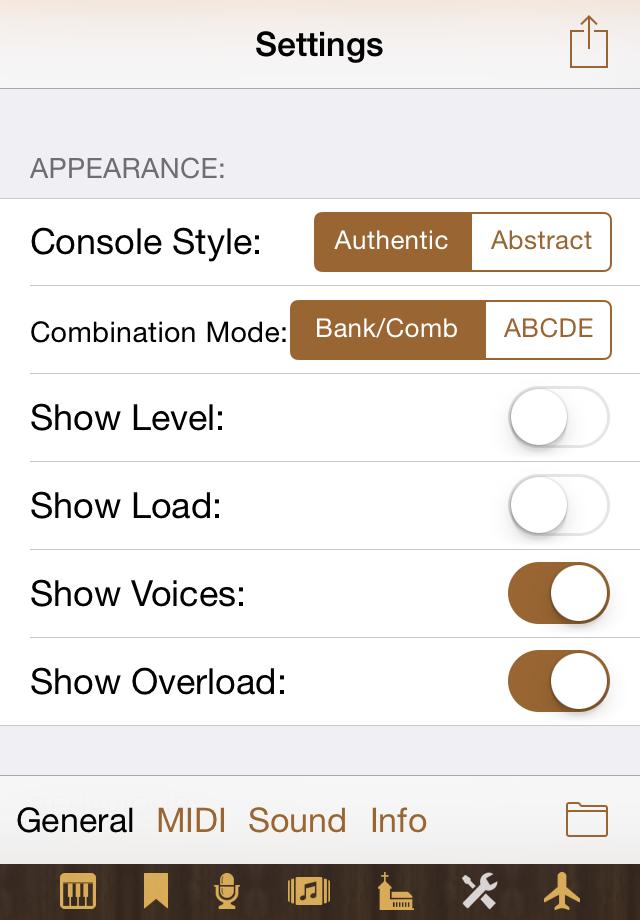
- Console Style: Here you can select the display style of the console. Authentic means that the Console view tries to mimic the real console, while Abstract is optimised for usability. You will see the changed style when you return to the Console view.
- Combination Mode: This setting controls whether the Console view shows buttons for bank/combination selection or the buttons A,B,C,D,E for direct access to five combinations. It is available starting with Napo 4.4.
- Show Level: Here you can select if you would like the audio level to be displayed as a coloured vertical line at the left of the screen.
- Show Load: If this option is set, then the current load of the device will be displayed as a coloured horizontal line above the icon bar. With increasing load, this bar grows to the right where it changes from green to orange to red. Red means that you operate the device at overload and risk stuttering sound.
- Show Voices: If this option is set, then the number of active voices will be displayed in the right of the tab bar (if any voices are playing).
- Show Overload: If this option is set, then CPU Overload, I/O Overload and Reverb Overload conditions are signalled by yellow warning signs.
General - Behaviour ↑
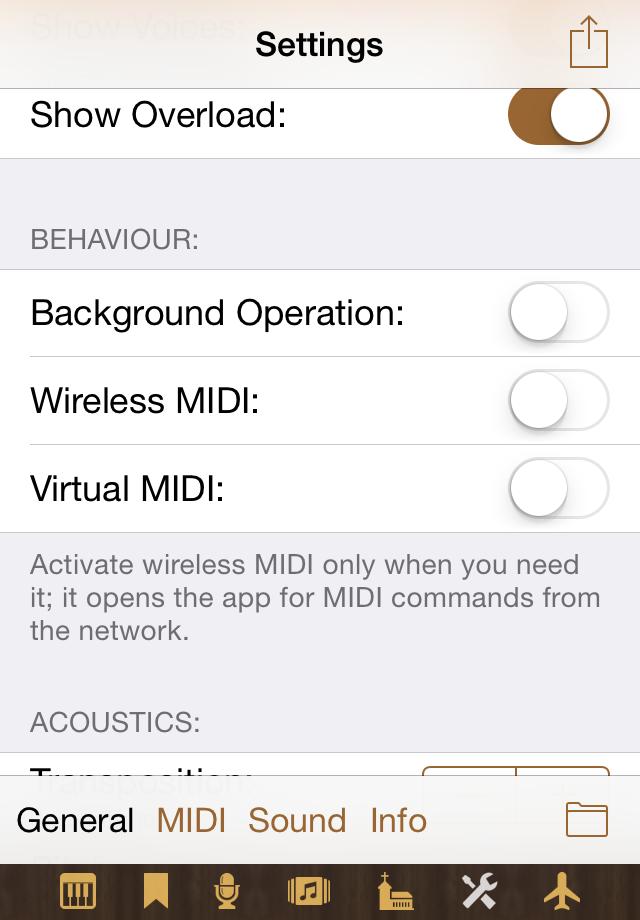
- Background Operation: By default, a Napo app is suspended when you switch to another app, i.e. its sound fades out and it stops processing MIDI events. With this switch you can configure the app to continue to run in the background. For example, you can start another virtual instrument app in the foreground and play both instruments. Or activate the Virtual MIDI switch also and start a virtual keyboard or MIDI player app that can send MIDI data to the Napo app's virtual MIDI channel. To save energy, do not activate this switch if you don't need the background operation functionality. However, after 15 minutes of idle time in the background, the app sets its audio session to inactive and as a consequence iOS suspends the app. In this case you have to bring the app to the foreground if you would like to continue to use it. "Idle" means that no voices are playing, which means that the idle mechanism does not work if the blower noise is active or stops are pulled when knobs noise is activated. You can check this by displaying the number of voices.
- Wireless MIDI: Napo can process MIDI commands received via wireless RTP-MIDI. For example, you can connect a USB MIDI keyboard to a MacBook and use the Mac's Audio-MIDI-Setup to configure a session for routing the MIDI data to your iOS device. Do not turn on wireless MIDI if you don't need it. There could be a joker on your network who likes to unsettle you by remotely playing your organ app.
- Virtual MIDI: Virtual MIDI is a way to let other apps that run on the same device send MIDI data to your Napo app. When you activate this switch, the Napo app creates a virtual MIDI port named by the app. The other app could be a MIDI player, a virtual keyboard, or a chord generator app, for example. Activating virtual MIDI activates the Background Operation switch also.
General - Acoustics ↑
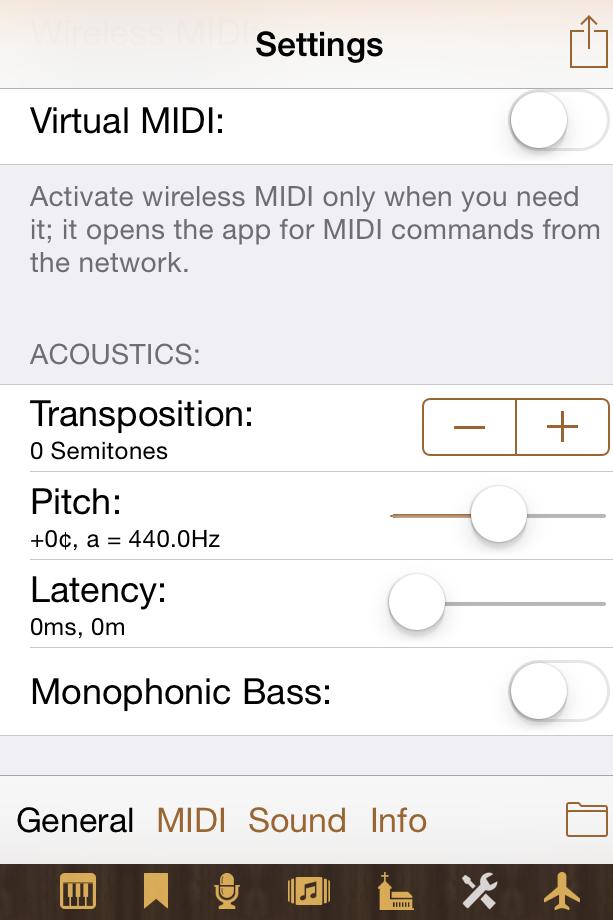
- Transposition: You can use this option to transpose the incoming MIDI signals up or down by up to six semitones. This does not increase the tonal range of the organ. If, for example, the highest note of the organ is g4 and you transpose up by two semitones, then you will get this g4 note by pressing the f4 key, but you will get no sound by pressing the g4 key.
- Pitch: The pitch of the organ depends on the sample set. Usually it is the unaltered pitch of the real organ. To adapt the sound of the app to other instruments, you can apply a pitch-shifting by up to +/- 100 cents. The pitch shifting is done by resampling with cubic interpolation. The slider allows a comfortable adjustment of the pitch with immediate audio feedback. To reset the pitch to 0 cents you can simply tap the + and then the - button of the transposition setting (or vice versa).
- Latency: Here you can configure an additional, artificial latency, which is given in milliseconds and by the corresponding distance between the audio source and your ears. The effect is that the sound does not start when you press a key but only after the additional time that is specified here. The purpose of this setting is to allow you practising for pipe organs where the console is positioned at a large distance to the pipes. At a speed of sound of 340 m/s, 100 ms latency correspond to a distance of 34 m. The values displayed in the Latency line do not include the latencies that are added by MIDI, the iOS audio system and the app's audio processing.
- Monophonic Bass: You see this switch only if the app includes monophonic bass functionality. When you turn on monophonic bass, then only the lowest active note of the pedal will play. The intention is to play a single pedal note with the keyboard if you don't have a MIDI pedal, to get a fuller sound. To achieve this, set both the channels of the manual and of the pedal to the value that your MIDI keyboard is using.
Then there are some options that are visible only if the app contains the respective noise files:
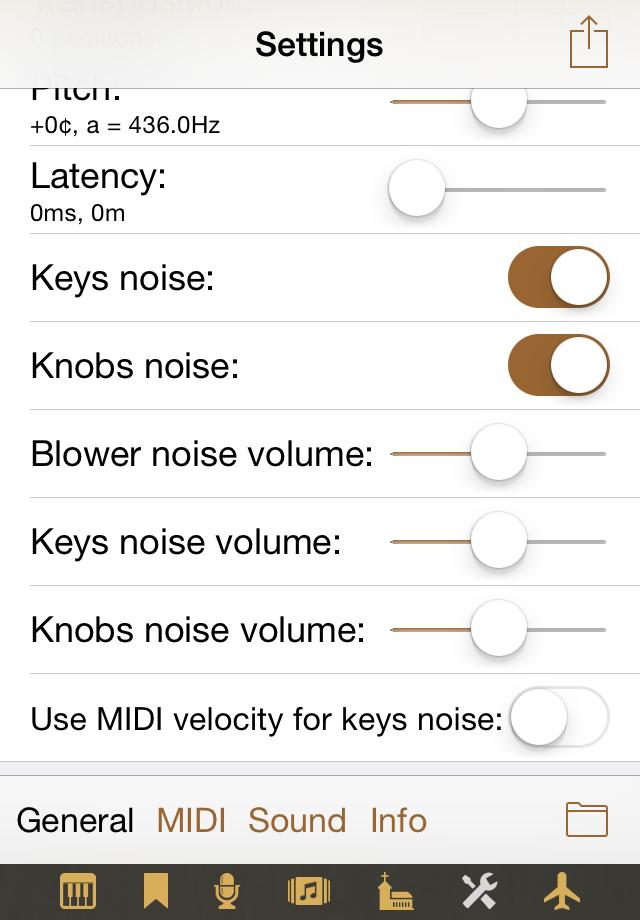
- Keys noise and Knobs noise: Activate these switches to hear these sounds when you play. While the usefulness of the knobs noise may be questioned, the keys noise not just makes the sound more lively, it also improves the feeling of authenticity for the organist.
- Blower noise volume, Keys noise volume and Knobs noise volume: These sliders allow you to set the volume of the respective sound.
- Use MIDI velocity for keys noise: If the app contains keys noise, and if your MIDI keyboard sends key velocity data, then with this switch you can advise the app to use the velocity data to control the level of the keys noise.
Many organ keyboards do not send velocity data. Even keyboards that do send velocity, mostly don't send release velocity. Release velocity is currently not used by Napo.
MIDI - Channels for Keyboards and and Note Ranges for Keyboards ↑

Both of these two sections have an entry for each keyboard of the organ. For a single-manual organ, for example, there is just one entry. For an organ with one manual and a pedal there are two entries, even if the pedal is fixed coupled. And so on.
The value of each channel setting is an element of the set {None, 0, ..., 15, All}, where None means that the keyboard does not play at all and All means that the keyboard should respond to data on all channels. To select a value, you can either use the - and + keys or tap Learn and then press a key on the MIDI keyboard that you would like to use to play the organ keyboard.
In the note ranges section, you can restrict the note ranges of the keyboards. Example: The organ app offers a manual and a pedal. You want to use your five-octave MIDI keyboard to play the pedal with the lowest octave and the manual with the upper four octaves. If your MIDI keyboard has split functionality, you are well off and can use this to control manual and pedal by two different MIDI channels. If your MIDI keyboard does not have split functionality and can send only on a single channel, you can still achieve the same result by setting both the manual and pedal to respond to the MIDI channel of the keyboard. Configure the pedal note range to use the lowest octave, and configure the manual note range to use the upper four octaves.
MIDI - Controllers for Volumes ↑
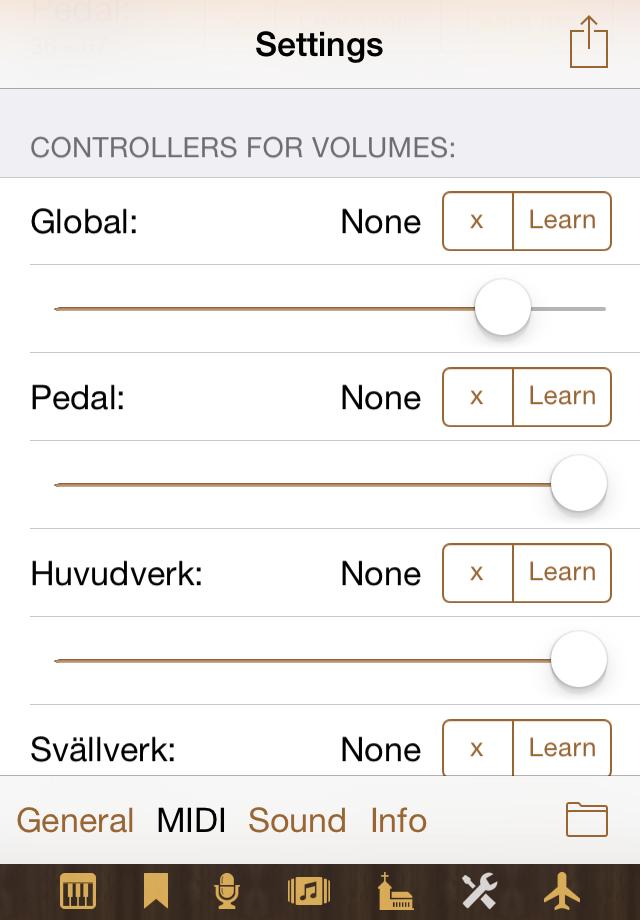
This section lets you configure MIDI controllers for manipulating the global volume and the volumes of single windchests. You do this by tapping Learn and then moving the controller, which usually is a volume slider or swell pedal. Tap x to remove a controller definition.
The sliders below the controller definitions give a visual feedback of the movements of the MIDI controllers. Of course you can also use these sliders to manipulate the volume settings directly. The first slider, Global, is coupled to the volume slider of the Console view.
MIDI - Switches for Stops ↑
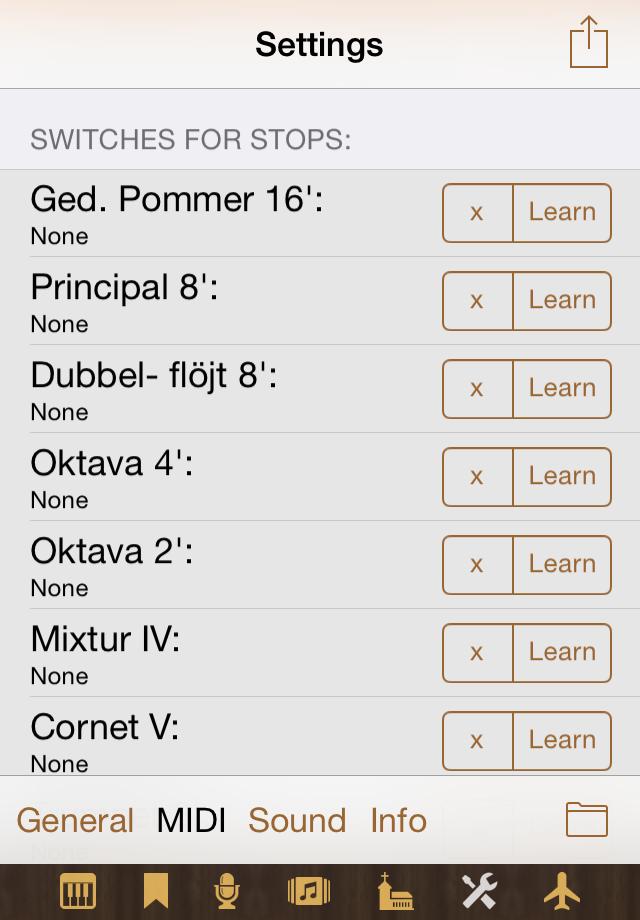
This section has an entry for each stop of the organ, where you can configure that the Console view's stop knob should respond to MIDI note-on or note-off messages. You do this by tapping Learn and then operating a button, key or switch at your MIDI keyboard or MIDI console which creates note-on or note-off messages. Tap x to remove a switch definition.
For each switch you can configure the mode of its operation. Normal means switch-on at note-on and switch-off at note-off. Inverse means switch-on at note-off and switch-off at note-on. Toggle at On means that the knob state is toggled by note-on messages, Toggle at Off means that the knob state is toggled by note-off messages,
MIDI - Switches for Couplers / Switches for Tremulants ↑
If the organ has couplers and tremulants, then there are sections to define switches for them. This works in the same way as the switches for stops.
MIDI - Buttons for Commands ↑
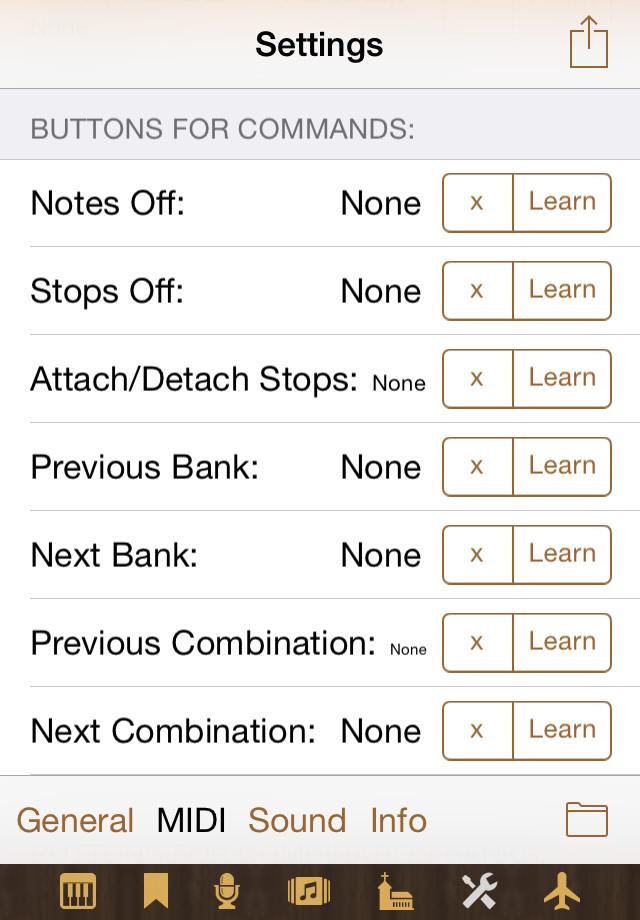
Here you can define that various commands can be triggered by MIDI note-on messages. Learn and x have the usual meaning.
MIDI - Buttons for Combination Banks / Buttons for Combinations ↑
In the same way you can use buttons or keys to directly select one of the first 16 combination banks or one of the first 16 combinations of the selected bank.
Sound ↑
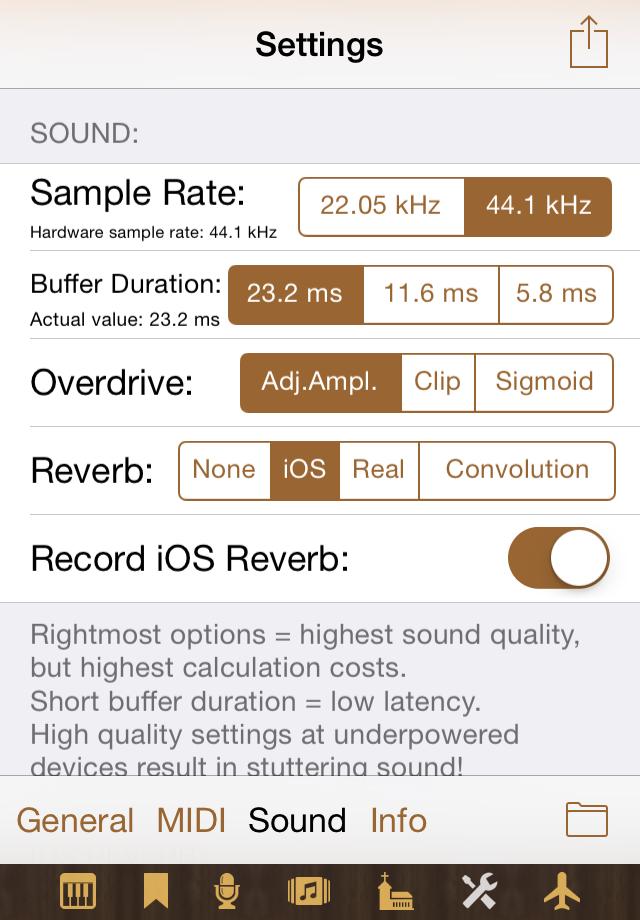
- Sample Rate: The default sample rate is 44100 Hz (or
48000 Hz), which is the sample rate of the WAV files of the
sample set. If it turns out that your device has not enough processing
power and the app is bothering you with overload warnings, then try
22050 Hz (or 24000 Hz, respectively). When you do this the first time,
the app creates downsampled WAV files. You can watch the progress in
the Info view. If you switch back to 44100 Hz you can
decide whether you would like to keep the downsampled files for future
usage or remove them to free up the disk space. iOS can also delete
these files if it detects a shortage of SSD space, but not while your
app is running.
Mind: With this setting you select the sample files' sample rate. Napo tries to switch the hardware sample rate of your device to the same value. Whether this succeeds, depends on the circumstances. For example if Audiobus is running, you cannot switch the hardware sample rate to 22050 Hz, which means that iOS needs to do additional processing of the audio data (but still the generated overall load is lower than with 44100 Hz). To give you a feedback, the hardware sample rate is displayed to the left of the sample files' sample rate. - Overdrive: This option is new in Napo 4.1. It was
introduced because some users don't like it when the app is
messing around with the general volume in overdrive situations, and
would rather prefer to hear some distortion. The available options are:
- Adj.Ampl.: This is the old behaviour. When an overdrive happens, the app will reduce the amplification. You see the volume slider in the Console view move downwards.
- Clip: With this setting, the app does not do any overdrive prevention. The signal is just clipped, and you will hear distorted sound.
- Sigmoid: As a compromise, this option applies a sigmoid transform to the signal. This does not help at heavy overdrive, but it can remove the distortion in not-so-heavy cases. As the transform is applied always, you would think that the benefit comes with the cost of an altered sound even when the signal is overdriven. In reality this is not the case – you won't hear a difference for normal signal values.
- Buffer Duration: The buffer duration tells iOS in
which time intervals it should ask the app for new sound data and thus
is a measure for how fast the app can react to your playing. Usually 23
milliseconds is a good enough value for organ playing. However if you
feel that this gives too much latency or jitter to your music, you can
try 12 milliseconds. There is also a 6 milliseconds option, but this
will probably be too challenging for current devices. Furthermore,
in the current implementation of Napo's tone generator there is
an additional internal buffer of 512 sample frames, which makes
it useless to choose 6 milliseconds buffer duration.
Again, the actual buffer duration may stay different from what you select, for example if you connect the Napo app to Audiobus. The actual buffer duration is displayed to the left of the selected buffer duration. - Reverb: The default setting is iOS, which cuts off the release part of the sample files and lets iOS create the reverb. Real plays the samples including their release part, which needs more processing power. (The notation Real is a bit misleading, as it is in general not known if the samples contain real or artifical reverb.) You can turn reverb off (setting None) if you would like to use an external effect unit or if you are playing in a large room with its own acoustics. Another option is to use Napo's convolution reverb.
Sound - iOS Reverb ↑
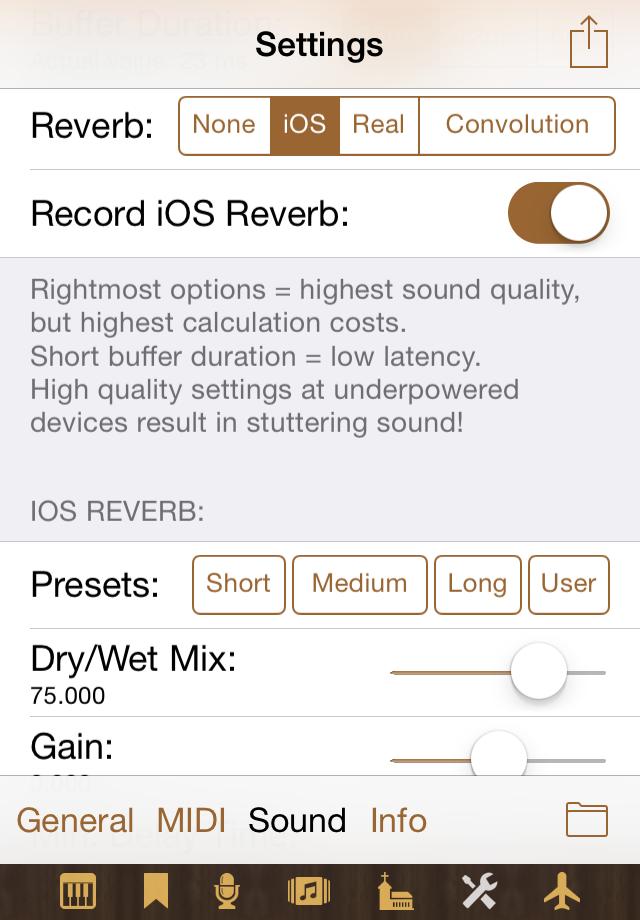
When you select iOS Reverb, you can either use one of the presets Short, Medium or Long, or you set the parameters of the reverb unit directly. There are seven of them, which can be controlled by sliders. You can save the current parameters as a User Setting and later recall it by tapping User. Beware: by choosing unsuitable values you can get deformed sound that reminds more of an overdriven drawbar organ than a pipe organ. We don't feel liable if you damage your ears or speakers or the nerves of your neighbours.
When you create a recording of your organ playing, the reverb is normally included. However, there is the option to deactivate the recording of iOS reverb, which allows you to play with reverb but record without reverb and add reverb later with any audio software of your choice.
Sound - Convolution Reverb ↑
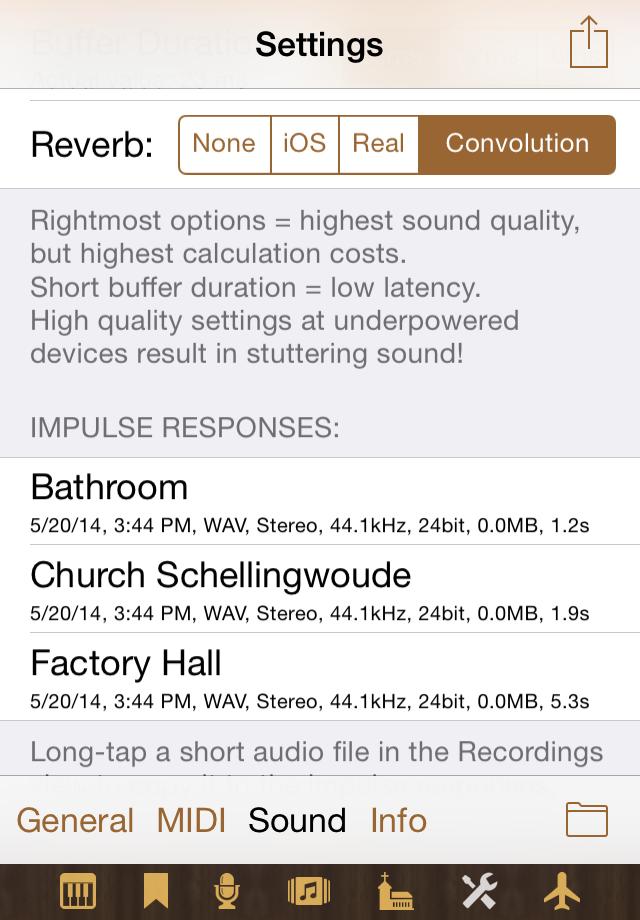
When you select Convolution Reverb, you see a list of available impulse responses. These can be factory impulse responses that are included with the app, or impulse responses that you uploaded to the device (this functionality is part of the Recordings view). Impulse responses can be renamed or deleted. Long-tap an impulse response to do this. You can reinstall the factory impulse responses anytime by tapping the button (Re)install factory IRs.
It must be clearly said that currently only devices like the iPad 4 or better are fast enough to cope with reasonable reverb lengths.
Info ↑
This view shows information about disk space and sample files, and it allows you to delete the 22050 Hz (or 24000 Hz) files after you have switched back to 44100 Hz (or 48000 Hz) in the Sound tab. The displayed elements are:
- Disk space: This is the total size of your SSD.
- Free space: This is the free space of your SSD. Check this value before your create downsampled files by switching to sample rate 22050 Hz.
- 44100 Hz: The number and total size of WAV files of the sample set.
- 22050 Hz: The number and total size of downsampled WAV files that have been created.
- Next you see a horizontal bar where you can watch the progress of the downsampling process.
- If you have created 22050 Hz files by switching to this sample rate, and then return to 44100 Hz, you can delete the 22050 Hz files by tapping the button in the last line.
If the sample files are based on 48000 Hz instead of 44100 Hz, then the above elements are labelled accordingly.
Save/Load ↑
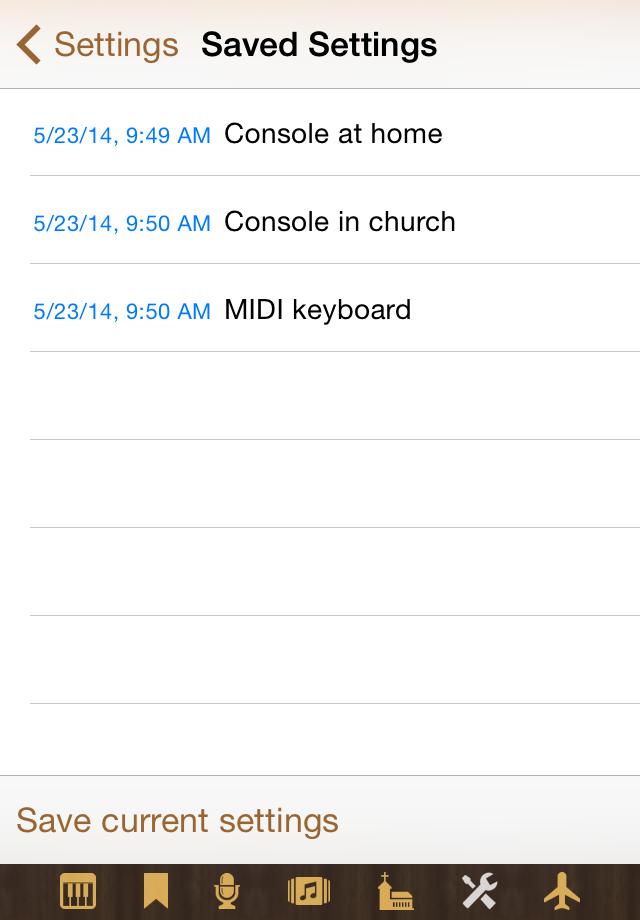
The list shows the settings sets that you have saved, with the time at which they were saved. A settings set contains all parameter values of the other four subviews. It is not possible to save only a subset of the parameters. Saving is done by tapping Save current settings and entering a name. When you long-tap a settings set, you get an action menu by which you can load the settings or rename or delete the set. Beware: Loading overwrites all your current settings values.
Like with the combinations, there is currently no convenient way to share
settings sets (this will follow in a future version), but you can access
the data with iTunes File Sharing. A settings set named name
is stored in a file named Settings.name.napo. Settings sets
created with a certain app can only be used with the same app or an
instance of this same app on another device.